
Ep 3 | The Business Acumen Podcast
How to Apply Business Acumen in Sales and Leadership with Ben Cook
"The more I could connect the sales role to the cash flows of the company... the more business trust I got."
— Ben Cook
"The more I could connect the sales role to the cash flows of the company... the more business trust I got."
— Ben Cook
Show Notes
In this action-oriented episode, host Stephen H. Covey is joined by Ben Cook, President of Acumen Learning. Following our deep dive into the 5 Business Drivers framework, Ben shares the "playbook" for moving from theory to execution.
The conversation explores how business acumen serves as the ultimate "connective tissue" within an organization. Ben reveals how top sales teams use the drivers to speak the language of the C-suite, how leaders use the model to align global teams around complex strategies, and how individual contributors can use this thinking to accelerate their career progression and find deeper meaning in their daily work.
Key Takeaways for Leaders
1. Stop Pitching, Start Partnering
Most salespeople walk into meetings with a "rote story" that never changes. Ben explains that elite sales professionals use the 5 Business Drivers to adapt their message based on the customer’s business stage (early vs. mature), industry, and functional role. Instead of asking "What keeps you up at night?"—a question Ben calls "lazy"—use the drivers to validate the challenges you already know they are facing.
2. The "Spinning Plates" of Executive Strategy
Ben uses a vivid metaphor: executives are spinning five plates (Cash, Profit, Assets, Growth, People) on five sticks. When a company engages in a merger, the Growth plate spins fast, but the Cash plate might wobble. Effective leaders identify which plate is currently the priority and align their team's initiatives to support it, ensuring they aren't "rowing in the opposite direction."
3. Reframing the Narrative: From "Cost" to "Impact"
In highly mission-driven industries like Pharma or Healthcare, "Profit" can sometimes feel like a dirty word. Ben shares a powerful example of a global pharma company that pivoted its internal messaging from a "cost-cutting story" to a "patient-outcome story." By framing efficiencies as a way to "free up cash to invest in the pipeline," they won the hearts and minds of their employees.
4. Career Acceleration Through Business Credibility
Thinking through the 5 Drivers isn't just for executives; it's a career catalyst. Ben shares the story of a Sales Director who rose to Group President by shifting his focus from "more sales" to "business impact." By connecting his role to the company's cash flows and operating efficiencies, he earned the trust of his peers and the C-suite alike.
The Strategic Alignment Process
To make business acumen stick, Ben suggests a "Macro to Micro" approach for leaders and their teams:
| Level | Action Step |
| The Macro | Listen to quarterly analyst calls through the lens of the Five Drivers. Which one is the priority? |
| The Function | Identify which team initiatives best support the company's macro-priority (e.g., Growth vs. Cash). |
| The Micro | In one-on-ones, help employees connect their specific tasks to that strategic "Big Picture." |
Additional podcast platforms
Listen to The Business Acumen Podcast on Apple Podcasts, Spotify, Overcast, Podcast Addict, Pocket Casts, Castbox, YouTube, Audible, or on your favorite podcast platform.
Podcast Transcript
Podcast Transcript
How to Apply Business Acumen in Sales Leadership with Ben Cook
Host: Stephen H. Covey Guests: Ben Cook (President of Acumen Learning)
Stephen (Host):
Last episode, Kevin Cope walked us through the five business drivers. Today we're gonna go to the next level. How do we actually use this thinking day-to-day to sell, lead, and execute on strategy? I'm joined by Ben Cook, president of Acumen Learning, who's worked with some of the world's top sales and leadership teams to put this model into action. Ben, I want to jump in on the sales side. When someone is having a sales conversation, how do the five business drivers change the way they prepare to lead a meeting?
Ben Cook:
I appreciate the question because oftentimes when you're going in to meet with somebody, there are a few things you should have thought through before you get there. You need to understand what’s "real" for them. They’re running a business; they’ve got priorities and trade-offs. Oftentimes, it's easy to say, "understand your customer's business," but what does that actually mean? Most salespeople think, "Well, you as a business want to grow, so let’s talk about how we can help you grow." That’s not always the case. The person you’re talking to, given their function, may not be thinking about growing. They might be thinking about operating more efficiently, speed to market, or attracting talent. If you’re talking to a COO or a CFO, growth is an outcome, but they are operating with a mindset of efficiency and cost management. Unless you understand those things, you come in with assumptions that aren’t relevant. These five drivers are a lens to apply to the function, the industry, and even the business stage—whether they are early-stage, hypergrowth, or late maturity.
Stephen:
So, what mistakes do salespeople make when talking to executives? And how does the framework help avoid them?
Ben Cook:
The largest mistake is that the pitch doesn’t change. The pitch is the pitch. "I’ve got my solution, I’ve got case studies, and here it is." But if you’re working with an early-stage business, they have a "speed to market" mindset. If it’s a mature business, you have multiple competitors and you need to drive operating leverage. If your questions don’t reflect the challenges they are most pressed to answer, it doesn’t land well. For example, a common question is: "So, what keeps you up at night?" My contention is you should have well thought through that before you ever got there. Given the 10-Q, the 10-K, or the latest analyst call, you should have a pretty good sense. Your job is to validate what you think their challenges are, not just ask a lazy question.
Stephen:
Do you have any examples where teaching the five drivers to a sales team directly influenced a deal?
Ben Cook:
There’s a lot, but one stands out. A sales director for a medical device company was in the southeast. He had some extra time before a meeting and decided to swing by a regional hospital system he hadn't called on before. He got an audience with the CFO. He sat down and said, "I can only imagine the challenges you’re dealing with given regulation, competition, and labor constraints, but I’m interested in your biggest priorities." The CFO talked about costs going up and labor being challenged. The sales director said, "It sounds like you have some constraints around the cash flows of your business." The CFO looked up and said, "That’s exactly my challenge." Because he tied it to cash flow—the CFO’s primary language—he was able to pivot to how their leasing and financial products could alleviate those specific cash flow problems. He didn't just push a solution; he adapted it to the story the CFO needed to solve.
Stephen:
That’s an amazing example. Shifting gears away from sales—how do the five drivers help align teams, specifically for a leader wanting to execute a strategy?
Ben Cook:
The five drivers are essentially an MBA in five words. As a leader, you can think of it like five plates on five sticks. The executive team is spinning these plates at different paces. For example, if a business is doing M&A, they are spinning up the Growth plate. But the Cash plate might wobble because they used capital for the acquisition. Then they have a duplication of costs, so the team has to move over and spin up the Profit plate for the next 6 to 12 months to integrate the business. It’s like the quote from Animal Farm: "All animals are created equal, but some are more equal than others." All five drivers matter, but at different times you have to be attentive to different ones. As a leader, you need to understand which plate is getting the focus and then do the heavy lifting to show your team how they align to that.
Stephen:
Have you seen situations where a strategy wasn't landing with employees until it was framed through this model?
Ben Cook:
We work with seven of the top ten pharma companies. We were working with one that was very innovative, and the employees were inspired by that innovation. However, they were dealing with margin compression and the company started focusing on efficiency and streamlining costs. The employees heard "cost, cost, cost" and there was a disconnect. They were inspired by patient outcomes, and "profit" felt like a dirty word. The company had to pivot the narrative. They stopped telling a "profit story" and started telling a "people story." They explained that by operating more efficiently, they were freeing up resources to reinvest in the early-stage pipeline and new products for the patients. Once the pivot happened, people started thinking creatively about efficiency because it was for the patient benefit, not just padding pockets.
Stephen:
So how does a company embed this so it sticks? One-off training rarely changes behavior.
Ben Cook:
We have attendees bring a real-world business priority they haven't solved yet into the class and use the five drivers to solve it. Another way is a cadence of staying connected. We have them listen to quarterly analyst calls. We ask them to do three things:
- Rank the drivers top to bottom for the company right now.
- Identify what they and their team are doing to align with those priorities.
- Have leaders use their one-on-ones to discuss those actions. With sales groups, we have them pull down their customer’s executive messaging and analyst calls. If they were to meet that customer next week, which of the five drivers are they focused on? It’s a crawl, walk, run process until it becomes second nature.
Stephen:
What is the role of the leaders at the company in reinforcing this?
Ben Cook:
That’s a critical step. We often bring the leaders in before the journey begins so they understand the concepts. After the class, the attendees exit with partners for a "return and report" process. They are also tasked with meeting their leader to pitch the most actionable steps they came up with. This merging of the leader and the participant drives real business impact.
Stephen:
Bringing it to the individual level—for someone not in the C-suite, how does this change how they show up at work?
Ben Cook:
It allows them to have more confident, strategic conversations "up," because that is the language expected of them. It also helps frontline managers translate executive talk "down" to the individual employee. I have one great story. A group president of a Fortune 70 client was reflecting on when he went through this training as a Director of Sales. He told me, "Ben, as soon as I realized that me pitching 'more sales' was an insufficient business case, and that I needed to connect my role to the cash flows and operating efficiencies of the business, the more credibility I gained." He said he became a well-rounded business person, and the more he adopted that, the faster his career progressed.
Stephen:
That’s amazing. Ben, this has been great. What’s one thing you hope every listener takes away from today?
Ben Cook:
First, most people have a "sphere of control." I would ask: Does excellence in your job enable the company's ability to succeed? If you shape your approach to align with the company’s highest priority, you get much more credibility. Second, before you meet with anyone, internal or external, think through: Which of the five drivers are they most focused on? People are looking for partners who can help them in their role. When you understand their priorities and build a linkage, you aren't working in isolation. You’re working together for the bigger picture. The satisfaction that comes when you can see the impact of your work is stunning and exciting.
Stephen:
Thank you, Ben. Words of wisdom. Thanks, everyone for tuning in.
Ben Cook:
Thanks, everybody.
Additional Episodes
Ep 1 | The Business Acumen Gap That Led to Acumen Learning with Stephen M.R. Covey & Kevin Cope
Stephen M.R. Covey and Kevin Cope share the story behind the founding of Acumen Learning and the problem they couldn’t ignore.
Ep 2 | The 5 Business Drivers Explained Simply with Kevin Cope
Kevin Cope breaks down a simple framework that helps you understand how any business actually works.
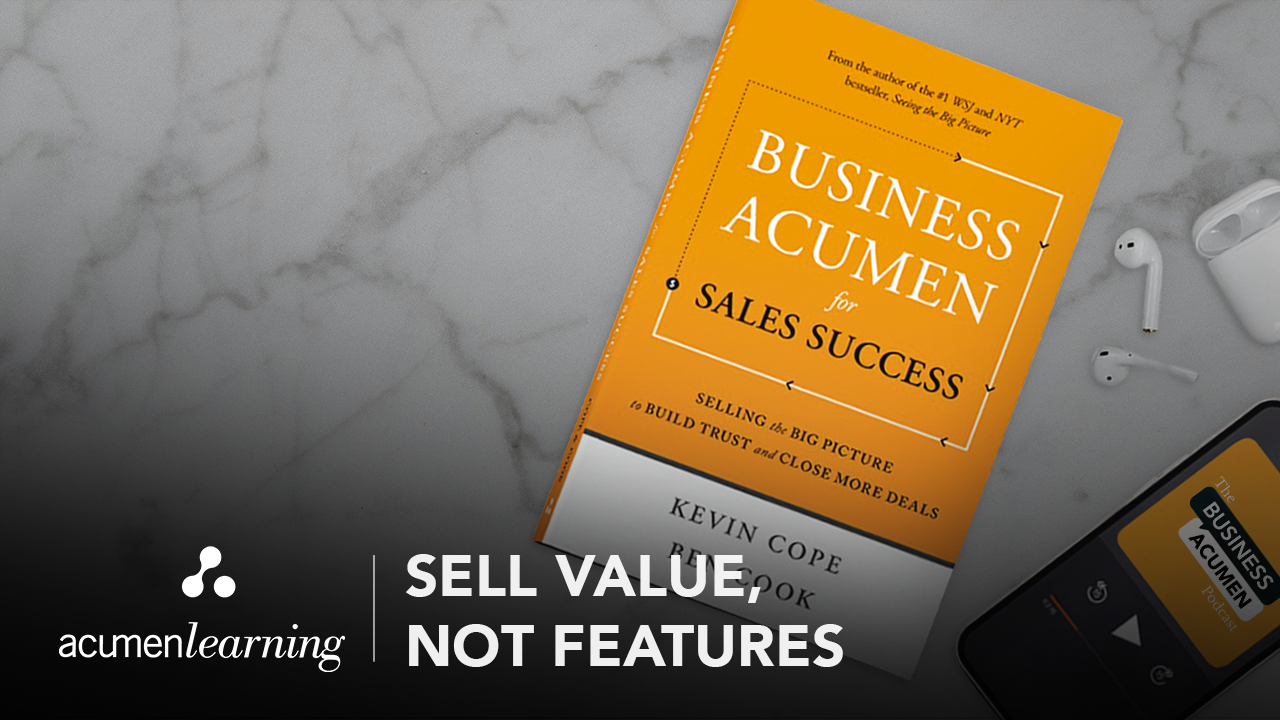
Ep 4 | Inside the Book: Business Acumen for Sales Success
Kevin and Ben discuss their book, Business Acumen for Sales Success, and why it was written now.